Among the hundreds of small Chinese manufacturers producing compact, high-performance hi-fi components—and quick to embrace the latest advances in technologies such as digital-to-analog conversion and Class D amplification—a handful stand out by delivering particularly well-executed products at affordable prices. Fosi Audio is certainly one of them. Still a relatively young brand, and perhaps not yet familiar to everyone, it has been steadily winning over audio enthusiasts with impressive products developed with the needs and feedback of the hi-fi community in mind.
We’ve always been fans of listening to music on physical media. Vinyl certainly has its appeal, but so do CDs: they’re inexpensive, remarkably durable when properly cared for, portable, easy to rip, and make great gifts. They require no subscriptions, internet connection, PC, mini PC, or any other kind of computer. And with the right playback equipment, they can deliver sound quality capable of satisfying even demanding audiophiles.
Having already enjoyed testing a number of Fosi Audio products—including the V3 Mono power amplifiers, the ZD3 DAC, the ZH3 DAC/headphone amplifier, and the i5 planar magnetic headphones—we were delighted to get our hands on the Merak. This new CD player combines an exceptionally compact form factor with an integrated headphone amplifier, very enjoyable sound, and some welcome modern features, including CD ripping and playback of music files from USB flash drives.
At the time of writing, the Merak is available on Amazon for just under €150, putting it firmly in the entry-level price bracket.
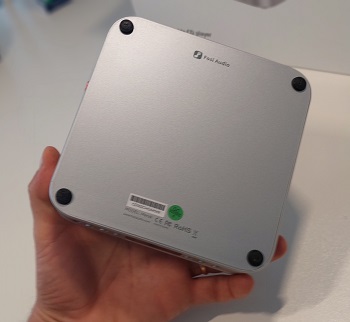
 The Merak is a remarkably small CD player, measuring just 15 cm in both width and depth—barely more than the diameter of a compact disc. Here are the full specifications provided by Fosi Audio.
Technical Specifications
- Chipset: SC6137D + CS43131 + TPA6120
- Maximum sampling rate:
- CD: 16-bit / 96 kHz PCM
- USB (USB flash drive): 16-bit / 96 kHz PCM
- Supported headphone impedance: 16–300 Ω
- Inputs/sources: USB-A (USB flash drive), CD
- Outputs: 3.5 mm headphone jack, line out, optical out, 12 V trigger
- Supported disc formats: CD-DA, CD-R / CD-RW (limited compatibility). Original pressed discs are recommended
- CD-R file formats: FLAC / WAV / WMA / AAC / MP3
- SACD playback: Only hybrid SACDs with a CD layer are supported
- USB playback formats: MP3 / WAV / FLAC / AAC / APE / WMA
- IR remote control: Operating range of up to 7 meters
- Power input: DC 5 V / 2 A
- Firmware updates: Via USB-A port using a USB flash drive
3.5 mm Headphone Output Performance (CD)
- Rated output power: L + R ≥ 210 mW + 210 mW (32 Ω / THD+N < 1%)
- Signal-to-noise ratio (SNR): 121 dB (A-weighted)
- THD+N: 0.002% (A-weighted)
- Dynamic range: 121 dB
- Noise floor: ≤ 3 µV (A-weighted)
Line Output Performance (CD)
- Output level: ≥ 2 Vrms
- Signal-to-noise ratio (SNR): 124 dB (A-weighted)
- THD+N: 0.0009% (A-weighted)
- Dynamic range: 124 dB
- Noise floor: ≤ 3 µV (A-weighted)
 On paper, this compact, modern CD player has a lot going for it. Digital-to-analog conversion is handled by the Cirrus Logic CS43131, a well-regarded, high-performance DAC chip commonly found in portable audio devices. Disc reading and track seeking are managed by the Silan SC6137D, a dedicated processor that also supports CD ripping and the decoding of digital audio files in FLAC, APE, OGG, MP3, WMA, and AAC formats.
The headphone amplification stage, meanwhile, uses the Texas Instruments TPA6120A2, a chip designed to deliver strong performance without the cost of more elaborate discrete-component circuitry. Its rated output of 210 mW into 32 Ω, however, is hardly exceptional. It’s also worth noting that the Merak does not support Bluetooth.
Thanks to Fosi Audio, we had the opportunity to spend plenty of time with this intriguing little CD player. Here’s how it performed in practice.
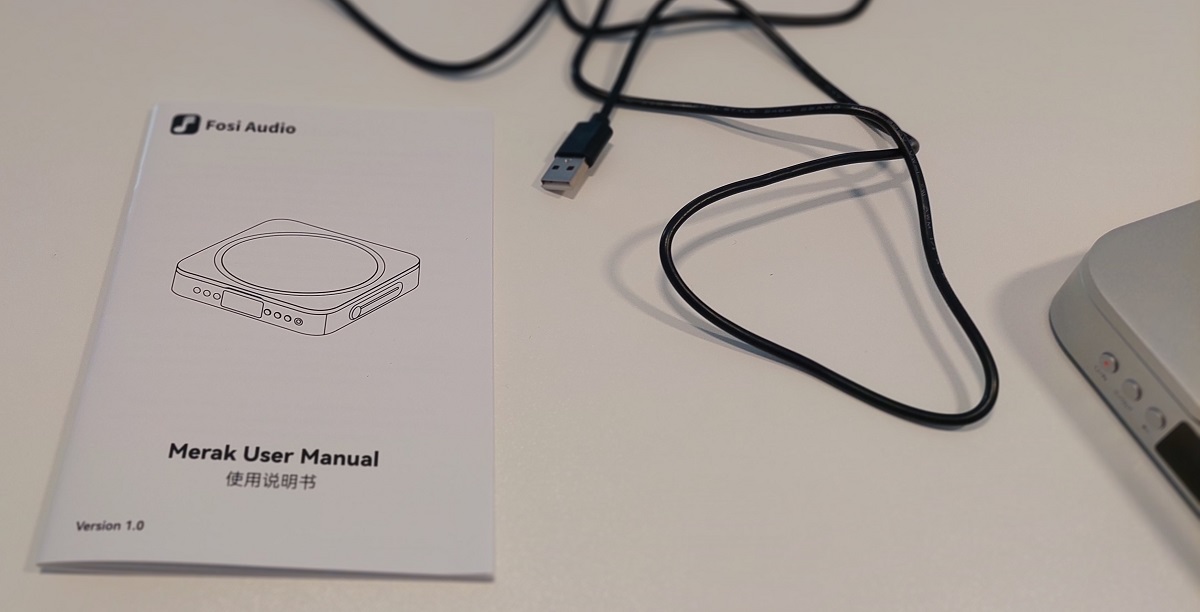
The Merak arrives in a well-padded cardboard box, much like the packaging used for other Fosi Audio electronics. Inside you’ll find the CD player itself, an IR remote control (batteries not included), a suitably long USB-A to USB-C cable, and a compact but informative printed user manual covering the player’s features.
There’s no power adapter in the box, so you’ll need to connect the Merak to a desktop or laptop USB port, or use a USB-A power supply rated for at least 5 V / 2 A. Adapters of this kind are extremely common, and chances are you already have one lying around for charging other devices. Still, given how little they cost, including one would have been a nice touch.
The unit cannot run on batteries, and there are no provisions for genuinely portable use. The Merak is very much a desktop CD player.
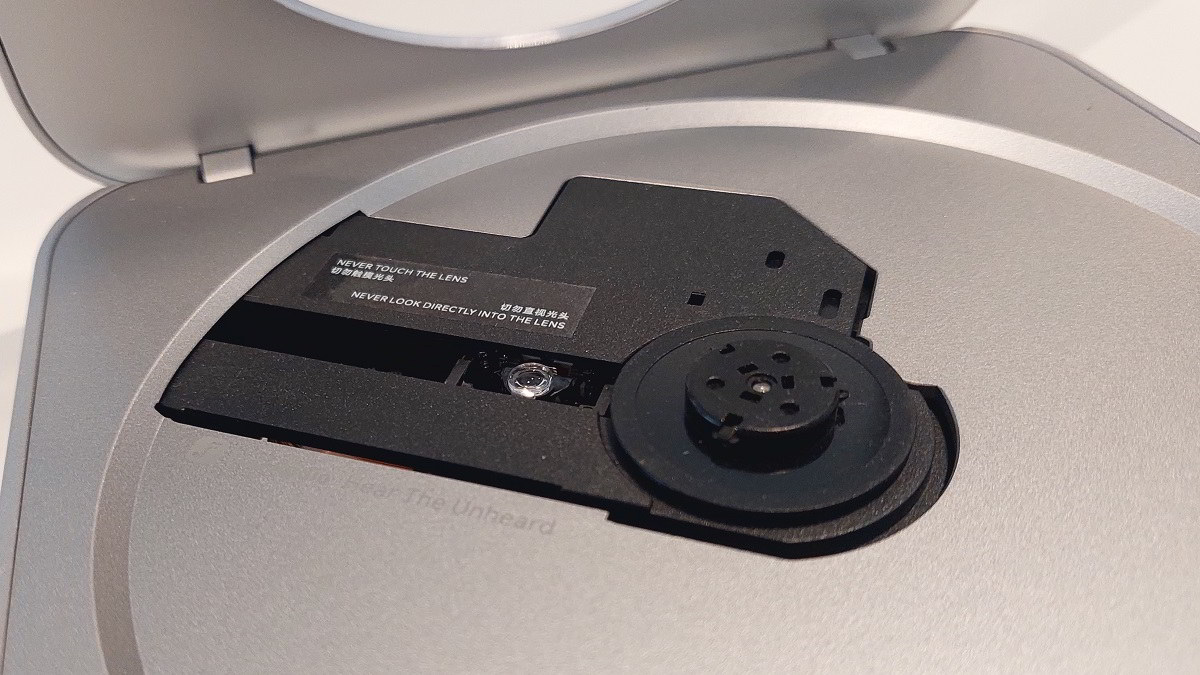 Once out of the box, the Merak looks almost surprisingly small. In our opinion, though, it’s also a very attractive little player, with a solid, reassuringly sturdy feel. It uses a top-loading mechanism: lift the lid, which has no locking latch, and place a CD on the spindle. Opening the lid while the player is powered on stops the disc from spinning; close it again and playback starts automatically. Simple and effective.
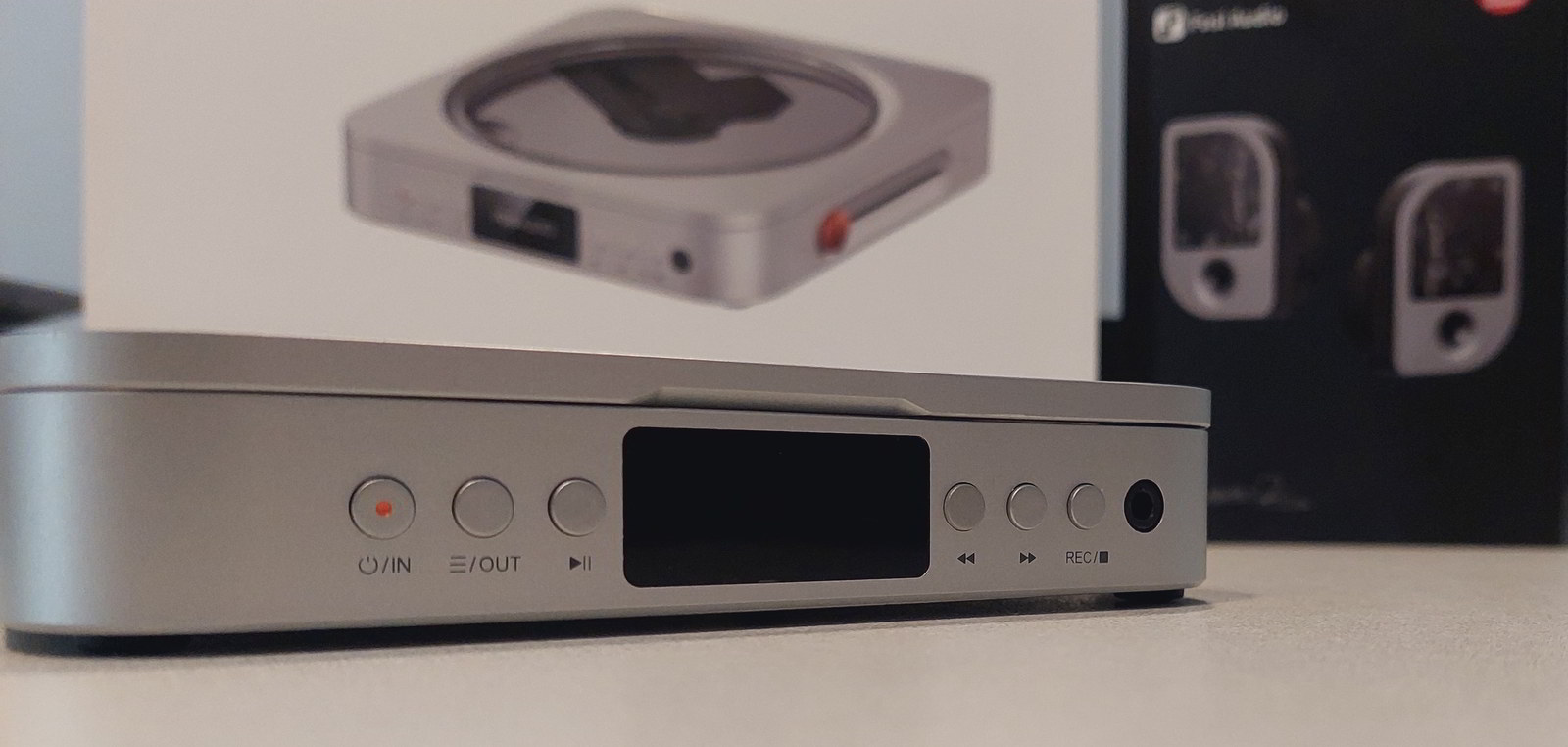
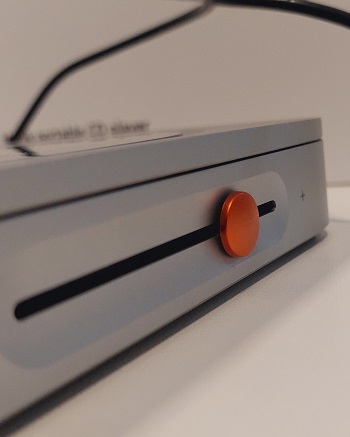
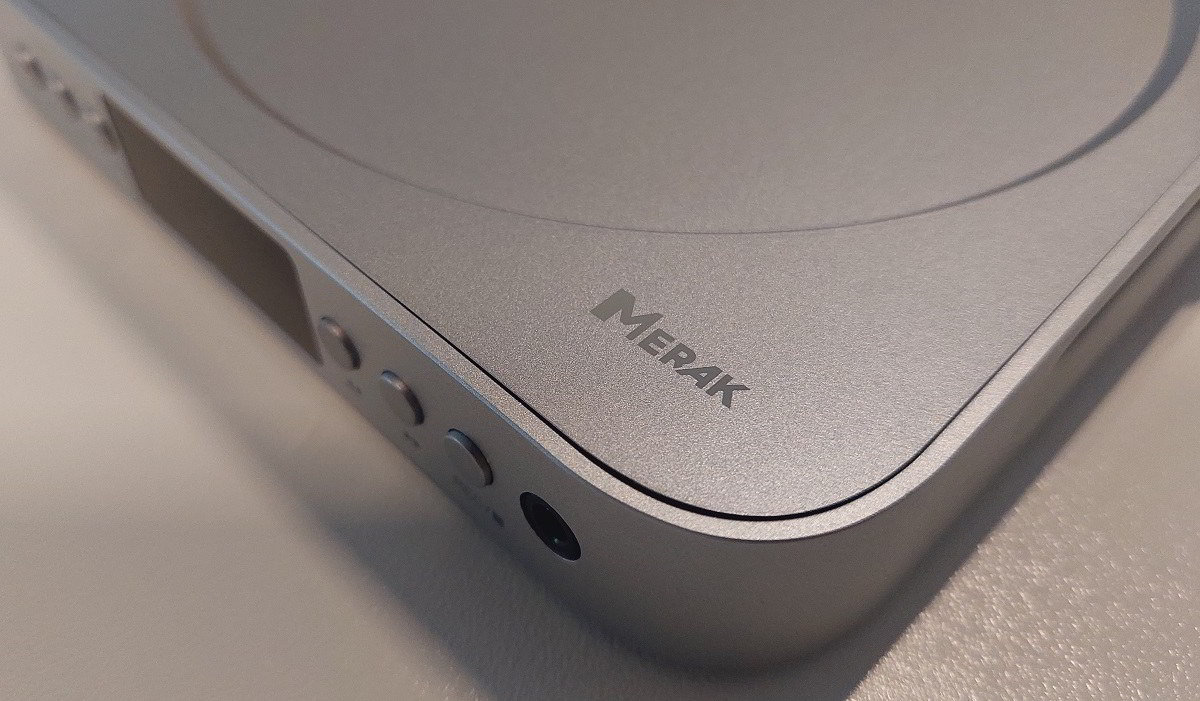
The front panel is dominated by a sharp, attractive three-line OLED display. Unfortunately, the text is a little too small to read comfortably from more than a short distance. Three identical buttons on either side of the display provide access to the main functions, while the 3.5 mm headphone output sits at the far right. We also particularly liked the side-mounted sliding volume control, which is both practical and satisfying to use.
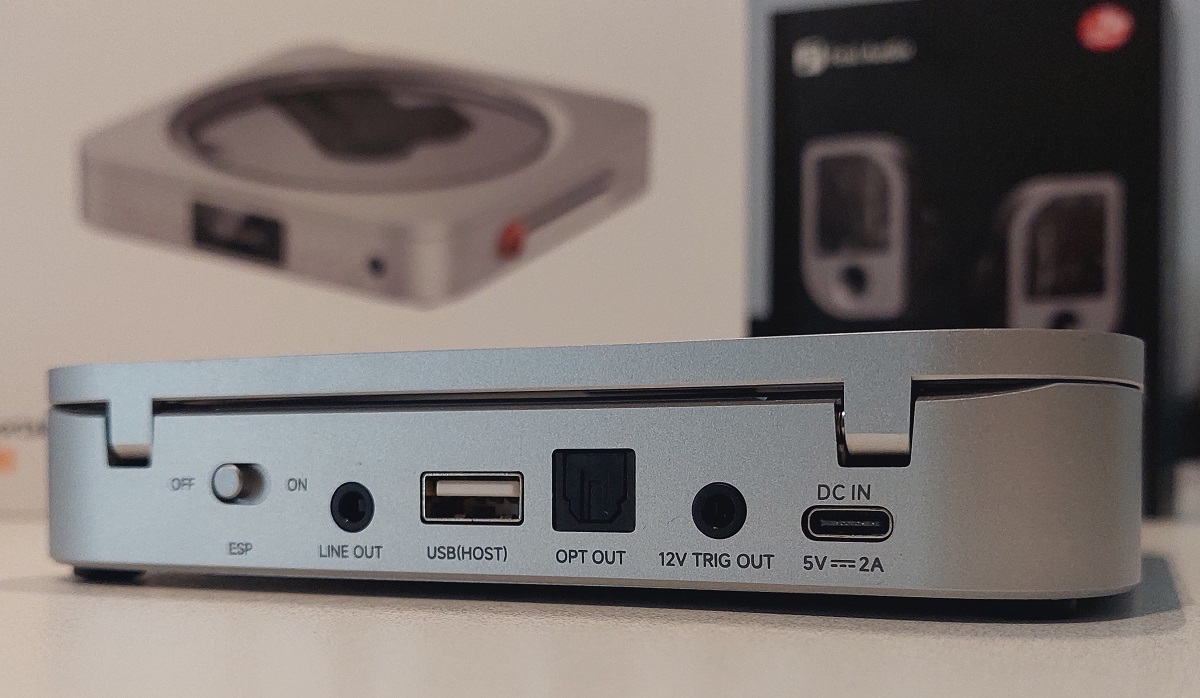
Around the back you’ll find a USB-C power input, a 12 V trigger output, an optical digital output, a USB-A port for flash drives, and a 3.5 mm analog line output. There’s also a switch to activate ESP (Electronic Shock Protection), which uses a small buffer to prevent playback interruptions caused by knocks or vibrations. It’s an unusual inclusion on a player designed primarily for desktop use, but there’s certainly no harm in having it.
Now for the listening tests. We spent several weeks using the Merak with Fosi Audio’s own Carbon12 IEMs, the Grado SR80e, and the HIFIMAN Sundara. These gave us a good selection of relatively affordable earphones and headphones known for delivering excellent performance for the money. We also evaluated the analog line output with several Class D amplifiers driving Indiana Line Nota 260X loudspeakers, and connected the optical output to various external DACs, including the Fosi Audio ZH3 and ZD3 and the considerably more expensive HIFIMAN Serenade.
One of the first pleasant surprises was that the Merak could drive the Sundara to more than acceptable levels, even if we had to push the volume slider close to its maximum setting. We hadn’t expected that. Across all the headphones we tried, the sound was thoroughly enjoyable and musical. Treble is clean and well controlled, while the bass isn’t particularly forward and doesn’t extend especially deep into the lowest octaves, but remains present and nicely defined. The midrange is arguably the star of the show, particularly with vocals, which consistently sound warm and lifelike.
The result is a wonderfully easygoing presentation that encourages extended listening. More than once, we put on a CD intending to listen to just a track or two, only to find ourselves happily playing the whole album from beginning to end.
 Considering that less than €150 buys you a CD transport, DAC, and headphone amplifier in a single unit, the Merak’s sonic performance represents genuinely compelling value.
Switching from the headphone output to the analog line output doesn’t fundamentally change the player’s sonic character. Using the optical digital output to feed an external DAC is a different matter, however, since that effectively turns the Merak into a dedicated CD transport. In this configuration, the final sound quality depends largely on the DAC you pair it with. A higher-end converter can deliver substantial improvements in detail retrieval, instrumental realism, and bass performance. Even so, we suspect many listeners will be perfectly happy with the Merak’s sound exactly as it is.
The additional features—playing digital audio files from a USB flash drive and ripping CDs to a USB drive—work well overall. Navigating files on a flash drive can become cumbersome because of the small display, though, and CD ripping takes place in real time while the disc is playing. That’s not the most convenient approach, and anyone accustomed to ripping discs on a PC will likely find it less sophisticated than using dedicated software such as Exact Audio Copy.
All things considered, we really enjoyed our time with the Merak. Our only real complaint—and one that fans of extreme miniaturization may well disagree with—is that an extra 5 cm of chassis length would hardly have made it a burden on anyone’s desk, while allowing room for a larger, more legible display and bigger buttons. At this price, however, the Merak’s performance and versatility are excellent, and we can readily recommend it to anyone shopping for a CD player in this budget range.
It’s an especially appealing option for listeners who don’t own a large hi-fi system but want to rediscover their CD collection: for very little money, they get a player, DAC, and headphone amplifier all in one. It’s equally attractive to those who already have a decent audio setup and simply want to add CD playback without spending a fortune.


Voi cosa ne pensate?